- ABOUT US
- EVENTS
- INVESTMENT FUND
- PARTNERSHIP SERVICES
- IMPACT INITIATIVES
-
SPACES
- HONG KONG
- Co-working space
- Event Space
- Prototyping Lab
- LONDON
- Co-working space
- Event Space
-
FABRICA X
- HONG KONG
- Campaign
- Online Store
- LONDON
- Exhibition
- Retail
- Subscribe

Innovative Ways To Tackle The Food Waste Problem
Many entrepreneurs and scientists are trying to introduce retail industry and charity organizations to new technologies that help them cut down on food waste and carbon emissions, and even turn food waste into other useful objects. In every aspect of their efforts to rescue food waste, including avoiding wastage as well as reducing and recycling waste, they are making use of cutting-edge technologies to prevent food from being sent to land fill.
(Image Courtesy: Unsplash)
Read More
00
Problem of Food Waste
Food wastage is not simply an ethical issue, but an economic and environmental problem. Globally, 1.3 billion tons of food every year goes to waste. At the same time, 1 in 11 people in the world do not have enough food to live. Economically, the supply chain needs to be improved as many foods go bad for various reasons before reaching the end consumer. Consequently, not only do these foods fail to accomplish their purpose of feeding humankind, the resources and expenses used to produce them, such as labor, natural resources and fertilizers, all go to waste. In 2019 alone, the total monetary value of wasted food came close to US$47 billion.
Many innovative companies have taken on the difficult task of turning this problem into business opportunities. These range from developing new technologies to extend the shelf-life of food, and upcycling leftovers and turning them into fashion items, thereby reducing the amount of food sent to landfills. In this issue, we share with readers how various entrepreneurs and non-profit organizations have used cutting-edge methods to extend the utility of food.
- One-third of food produced for human consumption is lost or wasted globally, which amounts to about 3 billion tonnes per year.
- There are 7 billion people on the planet, of which 925 million are experiencing hunger. Yet annually 1.3 billion tons of food is wasted, that is enough to feed 3 billion people.
- Food waste alone causes 10% of greenhouse gases.
01
Estimated Annual Global Food Waste By Sector
In 2019, there were a total of around 931 million tons of food waste across food service, household and retail these three main sectors:
- Food Service: 244 million tons
- Household: 569 million tons
- Retail: 118 million tons
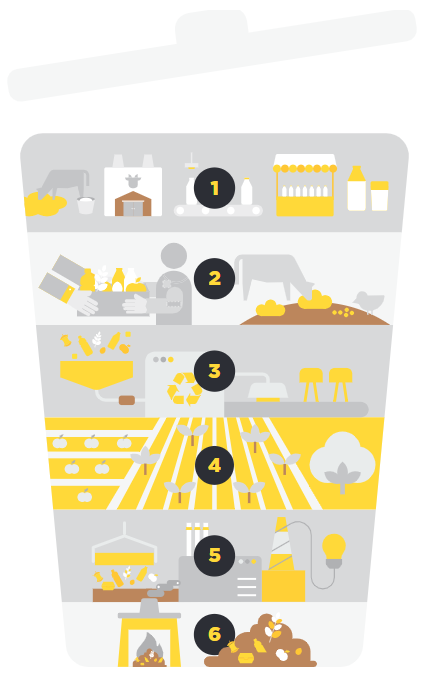
Food Recovery Hierarchy Best Practice to Worst Use
- Avoid Over-Production
Prevent wastage at every stage of food production.
- Recover The Edibles
Waste is not waste until we waste it. Recover the edibles and make better use of it e.g. donate to those in need, biochemical reprocessing.
- Reprocessing/Repurposing
Repurpose into other products.
- Composting
Centralize composting or anaerobic digestion in densely populated areas, and decentralize composting in rural areas.
- Energy Recovery
Process food waste with MBT (mechanical biological mixed waste treatment) to turn it into refuse-derived-fuel (RDF).
- Incineration /Landfill
Transport to landfill and / or incineration. This is the least acceptable.